
What Is Shadow AI? Risks, Security and How Sophos AI Defense Helps Businesses
Artificial Intelligence is changing how businesses work. Employees are using AI-powered chatbots, writing assistants, coding tools, browser extensions and automated agents to complete everyday tasks faster.
But there is a growing security challenge that many organisations are overlooking: Shadow AI.
An employee may upload a customer database to an online chatbot, use an AI browser extension to summarise confidential business documents or connect an AI agent to company applications without informing the IT department.
These activities may improve productivity, but they can also expose sensitive business information, create security vulnerabilities and introduce compliance risks.
For Indian businesses, particularly small and medium-sized enterprises (SMBs), the challenge is significant. AI adoption is moving faster than traditional IT approval and security processes.
So, how can organisations identify which AI tools employees are using, understand the associated risks and prevent sensitive data from being exposed?
This is where Sophos AI Defense comes in. It helps organisations discover, monitor and control AI usage across their IT environments, allowing employees to benefit from AI while helping businesses maintain security and visibility.
What Is Shadow AI?
Shadow AI refers to the use of artificial intelligence applications, tools, services and agents within an organisation without formal approval, visibility or oversight from IT and security teams.
It can include free AI chatbots, browser extensions, AI-powered software features, third-party integrations and autonomous AI agents.
Here are some common examples of Shadow AI in the workplace:
- Using personal AI accounts: An employee uploads customer information or internal business documents to a personal ChatGPT or Gemini account.
- AI browser extensions: Employees install AI-powered browser extensions that can access or process information from websites and documents.
- Unapproved AI applications: Teams use free or subscription-based AI platforms without informing the IT department.
- AI-enabled SaaS applications: Existing business applications introduce new AI features that employees start using without a security review.
- Unmanaged AI agents: Employees connect AI agents, plug-ins or integrations to business systems, files and applications without appropriate access controls.
The challenge is not simply the number of AI applications employees use. It is the lack of visibility into what information these tools access, how they process it and where that information may go.
How Common Is Shadow AI in Organisations?
Shadow AI is no longer a theoretical cybersecurity concern. Research highlighted by Sophos indicates that organisations are already experiencing significant gaps in AI visibility and governance.
According to Sophos’ October 2026 announcement:
- 69% of organisations suspect or have evidence that employees are using unsanctioned AI agents and tools.
- 82% of organisations have discovered Shadow AI agents in their environments during the past year.
- 90% of IT leaders are concerned about the risks associated with Shadow AI.
These findings highlight an important issue: organisations may be adopting AI across departments without having a clear understanding of the applications, agents and workflows accessing their business information.
For IT and security teams, discovering these activities is the first step towards managing AI-related risks.
Why Is Shadow AI a Business and Cybersecurity Risk?
Shadow AI is not just an IT management issue. It can affect data protection, business operations, customer trust and regulatory responsibilities.
Here are five major risks organisations should understand.
1. Sensitive Business Data Leakage
Employees may unknowingly share confidential information with unapproved AI platforms while trying to complete everyday tasks.
This information could include:
- Customer names, contact details and personal information.
- Financial statements and business reports.
- Employee records and HR documents.
- Proprietary business information and intellectual property.
- Software source code and technical documentation.
Once information is submitted to an external AI service, the organisation may have limited visibility into how that service processes, retains or handles the information.
2. Data Privacy and Regulatory Exposure
Indian businesses handling personal data must consider their obligations under the Digital Personal Data Protection (DPDP) Act, 2023 and applicable rules.
If employees share personal information through unauthorised AI applications, organisations may face additional challenges in maintaining appropriate data protection, access controls and accountability.
The use of AI does not remove an organisation’s responsibility to protect the personal data it handles.
3. Unauthorised Access Through AI Agents
Modern AI agents can do more than generate text. Depending on their permissions and integrations, they may access files, interact with applications, retrieve information and perform actions.
If these agents are not properly governed, they can introduce additional security risks, including excessive permissions, unintended access and misuse of connected resources.
4. Increased Cybersecurity Exposure
Unapproved AI applications, browser extensions and integrations may introduce vulnerabilities or create additional entry points for attackers.
Security teams that cannot identify these applications may struggle to assess their risks or investigate suspicious activity.
5. Lack of Visibility and Accountability
When AI usage is spread across personal accounts, browser extensions, applications and automated agents, IT teams may not have a reliable picture of what is happening.
This makes it difficult to establish acceptable-use policies, investigate incidents and demonstrate effective security governance.
For SMBs and mid-market organisations without dedicated security operations teams, these challenges can be particularly difficult to manage.
Why Blocking All AI Tools Is Not the Solution
AI applications are becoming valuable productivity tools across software development, marketing, finance, customer service and business operations.
Completely blocking AI applications may reduce productivity and encourage employees to find alternative ways to access them through personal devices or accounts.
Instead of restricting AI adoption altogether, organisations should focus on responsible AI usage.
A practical AI security strategy should answer three questions:
- What AI tools are employees using? Identify approved and unapproved applications, agents and services.
- What information can these tools access? Understand where sensitive data may be exposed.
- How can risky activities be controlled? Apply policies and security measures to prevent inappropriate data sharing.
This is the approach behind Sophos AI Defense.
How Sophos AI Defense Helps Organisations See, Control and Secure AI Usage
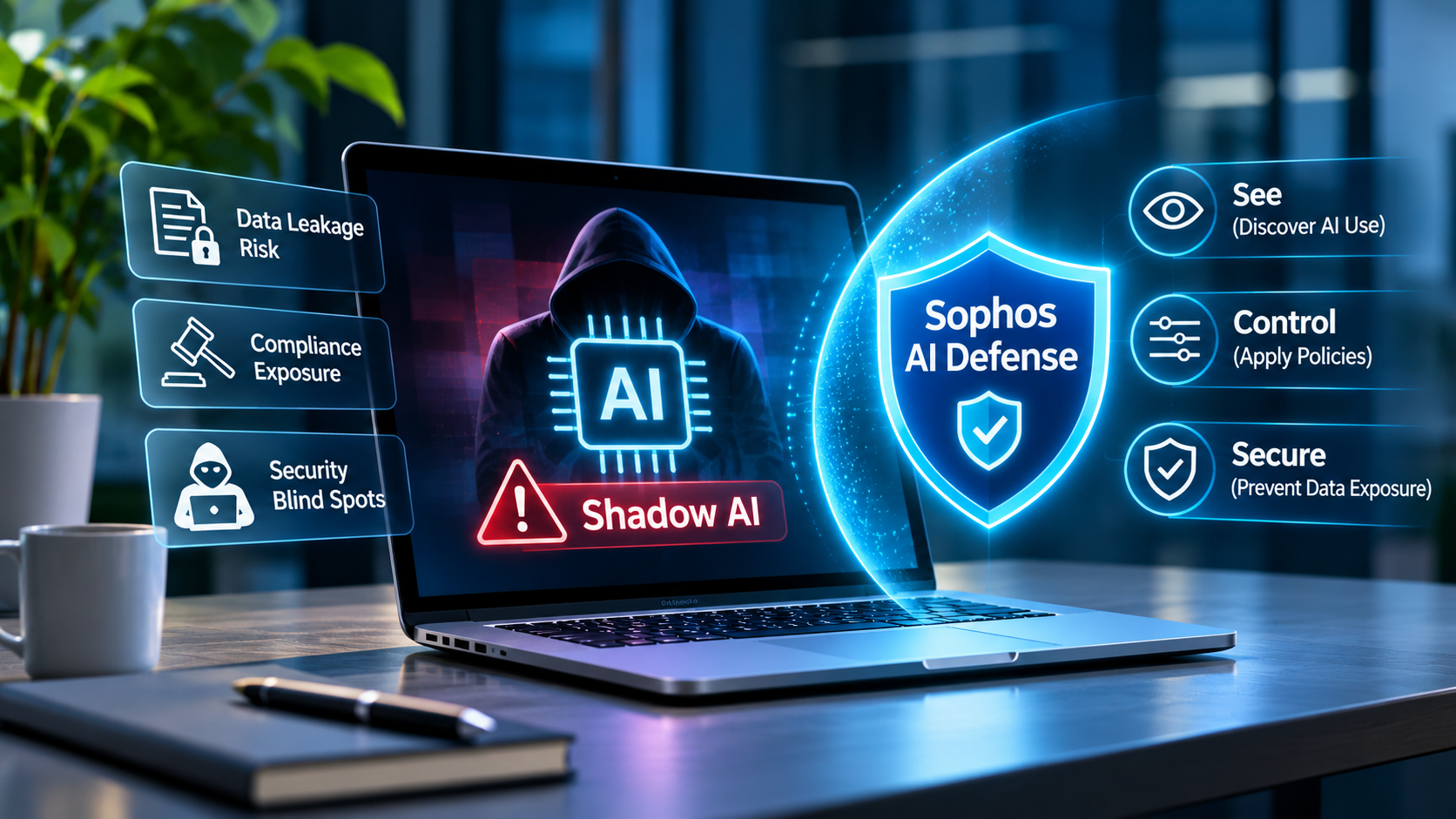
Sophos AI Defense is designed to help organisations manage AI-related security risks through three key capabilities: See, Control and Secure.
Delivered through Sophos Fusion, it brings together security signals from existing Sophos protection technologies to improve visibility and enforce policies across the organisation.
1. SEE – Discover Shadow AI Across Your Organisation
The first step in managing Shadow AI is understanding what is actually being used.
Sophos AI Defense helps identify AI applications and services operating across an organisation, including tools that have not been formally approved by IT.
It provides visibility into supported AI application categories, including:
- Browser-based AI platforms such as ChatGPT, Claude and Copilot.
- AI coding assistants such as Claude Code and Cursor.
- Desktop AI applications.
- Emerging AI agents and related services.
It also helps security teams understand which users are accessing these services and identify potential areas of concern.
Business benefit: Gain better visibility into AI adoption, identify unsanctioned AI applications and understand where potential data exposure risks exist.
2. CONTROL – Apply Policies to Manage AI Usage
Discovering AI applications is only the beginning. Organisations also need the ability to manage how employees use them.
Sophos AI Defense helps administrators establish policies to allow, warn about or block specific AI activities.
It evaluates contextual signals such as who is accessing an AI service, how the activity is taking place and what data may be involved.
This helps organisations distinguish normal business usage from activities that require intervention.
For example:
- Allow access to approved AI applications.
- Warn users about activities that may violate company policies.
- Block selected AI services or activities based on configured policies.
- Apply appropriate controls across supported devices and environments.
Business benefit: Establish consistent AI usage policies without unnecessarily restricting legitimate business activities.
3. SECURE – Protect Sensitive Data Through Real-Time Guardrails
The most important aspect of AI governance is protecting business information.
Sophos AI Defense provides real-time guardrails designed to inspect prompts, file uploads and other supported AI interactions as they happen.
This helps organisations identify and prevent potentially risky data-sharing activities before sensitive information is exposed through AI applications.
By combining signals from different security layers, Sophos AI Defense helps organisations move beyond simply identifying AI applications towards actively managing the associated risks.
AI-related activity can also feed into Sophos Fusion, enabling security teams using Sophos XDR and Sophos MDR to investigate and respond through their existing security workflows.
Business benefit: Strengthen data protection, reduce the risk of accidental information exposure and improve the organisation’s ability to respond to AI-related security events.
Do You Need New Hardware or Additional Security Infrastructure?
One of the advantages of Sophos AI Defense is that it builds on the Sophos security ecosystem rather than requiring organisations to introduce a completely separate AI security platform.
It uses existing Sophos security sensors and capabilities to gather information about AI activity across supported environments.
These can include:
- Sophos Endpoint.
- Sophos Firewall.
- Sophos Protection for Linux.
- Sophos DNS Protection.
- Sophos Protected Browser.
- Sophos Data Lake.
However, the required sensors must be configured appropriately, and visibility and enforcement capabilities can vary depending on the products and environment deployed.
Sophos AI Defense is delivered through Sophos Fusion, its AI-native cybersecurity defence system.
Sophos AI Defense Licensing Requirements
Sophos AI Defense is available as an add-on for eligible organisations using:
- Sophos EDR.
- Sophos XDR.
- Sophos MDR.
Organisations must also have an eligible Sophos Fusion environment with the required Security Operations capabilities enabled.
The licensing requirements and subscription quantities should be confirmed with Sophos or an authorised partner before implementation.
What About Microsoft 365 Copilot and AI Data Security?
Many organisations are adopting Microsoft 365 Copilot and other AI-powered business applications to improve workplace productivity.
However, introducing AI into existing business workflows raises important questions about data access, permissions and information protection.
For organisations using Microsoft 365, Microsoft Purview provides data security and compliance capabilities that help discover, assess and manage risks associated with AI applications and interactions.
For example, Microsoft Purview’s Data Security Posture Management capabilities can help organisations understand sensitive data exposure and strengthen information protection controls.
Sophos AI Defense and Microsoft Purview address complementary aspects of AI security:
- Sophos AI Defense: Provides visibility and policy enforcement for supported AI applications and activities across the wider security environment.
- Microsoft Purview: Helps organisations manage data security, information protection and compliance risks associated with Microsoft 365 and supported AI applications.
Together, these technologies can contribute to a more comprehensive AI security and data protection strategy.
How Indian Businesses Can Get Started with Shadow AI Management
Organisations do not need to wait for a security incident to start managing Shadow AI.
A structured approach can help identify risks and introduce appropriate controls without disrupting business operations.
Step 1: Assess Existing AI Usage
Identify which AI applications, browser extensions, agents and services employees are using. Understand which departments rely on AI and for what business activities.
Step 2: Identify Sensitive Data Exposure
Evaluate whether employees are sharing customer information, financial records, intellectual property or other confidential business data through unapproved AI platforms.
Step 3: Establish an AI Acceptable-Use Policy
Define which AI tools employees can use, what information they can share and which activities are restricted. Communicate these policies clearly across departments.
Step 4: Implement AI Security Controls
Use suitable security solutions such as Sophos AI Defense to discover AI applications, establish policies and apply controls to risky AI activities.
Step 5: Monitor and Review Regularly
AI applications and agents continue to evolve. Regularly review AI usage, policy effectiveness and potential security incidents to keep your organisation protected.
Why Choose CosmicTech for Shadow AI Discovery and Sophos AI Defense?
As organisations adopt AI across their business operations, understanding and securing AI usage is becoming an important part of enterprise cybersecurity.
CosmicTech Infosystems Pvt. Ltd. helps businesses strengthen their IT infrastructure, cybersecurity and data protection strategies through enterprise technology solutions.
As a Bengaluru-based managed IT services provider and Microsoft Solutions Partner, CosmicTech supports SMB and mid-market organisations across India.
With Sophos AI Defense, businesses can take a more structured approach to identifying and managing Shadow AI.
CosmicTech can help organisations:
- Assess existing AI usage and identify potential Shadow AI exposure.
- Identify AI applications, browser extensions and agents requiring attention.
- Evaluate potential data leakage and security risks.
- Plan AI acceptable-use policies and governance controls.
- Implement suitable Sophos security solutions.
- Support ongoing security monitoring and management through appropriate managed services.
Start with a Shadow AI Discovery Assessment
Before implementing new restrictions or investing in additional security solutions, it is important to understand what is already happening across your organisation.
CosmicTech’s Shadow AI Discovery Assessment is designed to help businesses:
- Identify AI tools, applications and agents in use.
- Understand potential exposure of sensitive business information.
- Highlight areas requiring stronger security controls.
- Recommend a practical AI governance and protection strategy.
Don’t let unseen AI usage become an unseen business risk.
Connect with CosmicTech to understand your organisation’s Shadow AI exposure and explore how Sophos AI Defense can help you adopt AI more securely.
Frequently Asked Questions About Shadow AI and Sophos AI Defense
1. What is Shadow AI?
Shadow AI refers to the use of AI applications, tools, services and agents within an organisation without formal IT approval or security oversight. Examples include personal AI accounts, unapproved chatbots, AI browser extensions and unmanaged AI agents.
2. Is Shadow AI the same as Shadow IT?
Shadow AI is a specialised category of Shadow IT. Shadow IT refers to unauthorised software, applications and services used within an organisation. Shadow AI specifically involves artificial intelligence tools and agents that may process company information, access business resources or perform automated actions.
3. What are the biggest risks of Shadow AI?
The main risks include sensitive data leakage, unauthorised access to business information, security vulnerabilities, regulatory exposure and limited visibility into AI-related activities.
4. How common is Shadow AI in businesses?
Sophos reports that 69% of organisations suspect or have evidence of employees using unsanctioned AI agents and tools, 82% have discovered Shadow AI agents in their environments during the past year, and 90% of IT leaders are concerned about Shadow AI risks.
5. What is Sophos AI Defense?
Sophos AI Defense is a cybersecurity capability delivered through Sophos Fusion. It helps organisations discover AI applications, identify potentially risky activity, establish usage policies and apply real-time guardrails to help prevent sensitive data exposure.
6. Can Sophos AI Defense block unauthorised AI applications?
Yes. Sophos AI Defense supports policies that can allow, warn about or block specific AI applications and activities, depending on the configured policy and supported security sensors.
7. Does Sophos AI Defense require additional hardware?
A separate dedicated AI security appliance is not generally required. Sophos AI Defense uses existing Sophos security sensors and infrastructure. However, organisations must meet the relevant platform, configuration and licensing requirements.
8. Who can use Sophos AI Defense?
Sophos AI Defense is available as an add-on for eligible Sophos EDR, Sophos XDR and Sophos MDR customers using the Sophos Fusion platform. Specific subscription and platform requirements apply.
9. Is Shadow AI relevant to small and medium-sized businesses?
Absolutely. SMBs frequently adopt cloud-based AI applications without having dedicated IT security teams to monitor their usage. Shadow AI management helps these businesses improve visibility, protect sensitive information and establish appropriate AI usage policies.
10. How does Sophos AI Defense support DPDP Act-related data protection?
Sophos AI Defense can help organisations identify AI applications, establish security policies and reduce the risk of sensitive information being exposed through supported AI interactions. These capabilities can support broader data protection practices under India’s DPDP framework, but they do not independently establish legal compliance.
11. How does Sophos AI Defense work with Microsoft 365 Copilot?
Sophos AI Defense helps provide visibility and controls for supported AI applications across the wider IT environment. Microsoft Purview provides complementary data security and compliance capabilities for Microsoft 365 and supported AI services. Organisations can evaluate both based on their security and data protection requirements.
12. How can businesses get started with Shadow AI management?
Businesses can begin with a Shadow AI Discovery Assessment to identify the AI applications and agents in use, understand potential data exposure and determine the controls required. CosmicTech can help assess the environment and explore an appropriate Sophos AI Defense deployment.
Contact CosmicTech for a Sophos AI Defense Demo
Website: https://www.cosmictech.in/
Email: enquiry@cosmictech.in
WhatsApp: https://wa.me/918951979498
See the AI. Control the Risk. Secure Your Business.